Menopause, Weight Gain, and Belly Fat: What to Eat to Limit the Changes
Written by Juliana Dosy, M.Sc. Nutrition · Updated
"Juliana, since menopause I've had a harder time keeping my weight steady, and it feels like I'm gaining around the middle. I'm more tired too. Is this normal? And what can I change in my eating to limit it and get my energy back?"
Short answer
Menopause does not sentence you to weight gain. What changes is where your body stores fat and how it manages muscle — and on both you have more leverage than you've been told. The answer isn't eating less: it's feeding your body better while protecting your muscle, with protein at every meal, fiber, a balanced plate and resistance training.
First, the reassuring part
Menopause does not sentence you to weight gain. It isn't written into your hormones as a certainty. What changes is where your body tends to store fat and how it manages muscle — and on both of those, you have more leverage than you've been led to believe.
The drop in estrogen that comes with menopause nudges the body to redistribute some fat toward the abdomen. That's why a woman can see her shape change while the scale barely moves. Alongside that, age does its work: without effort to prevent it, we gradually lose muscle — a process called sarcopenia. And muscle is precious. It supports strength, independence, and metabolic health — your body's ability to manage blood sugar, insulin, and energy well.
The conclusion runs against most of what you'll hear: the answer isn't to eat as little as possible. It's to feed your body better while protecting your muscle. Eating less and losing muscle would leave you weaker, more tired, and with a slower metabolism — the opposite of the goal. Here's how I work through it with my clients.
Protein at every meal, not just dinner
This is the first lever and the one most often missed. Protein helps preserve muscle mass, and that becomes central with age. Most women I work with eat very little in the morning, a bit at lunch, and load almost all of it at dinner — exactly backwards for protecting muscle. The body uses protein better when it's spread across the day.
In practice, aim for a protein source at breakfast, lunch, and dinner: eggs, Greek yogurt or skyr, fish and seafood, chicken and lean meats, tofu, tempeh, lentils, chickpeas, and other legumes. Protein also extends satiety — that feeling of being genuinely full that keeps you from snacking an hour later.
One point I repeat constantly: protein and resistance training work together. Eating protein without challenging your muscles supplies the raw material without sending the build signal. When your health allows, work gradually toward at least two resistance-training sessions a week, on top of your other activity. It's the pairing that makes the difference after 50 — not one or the other.
Keep carbs — just choose them better
No, you don't have to cut bread, rice, potatoes, cassava, yam, or plantain because you're in menopause. Carbohydrates are one of the body's main fuels, and cutting them mostly brings fatigue and cravings. The problem is almost never the starch itself — it's the portion and what goes with it.
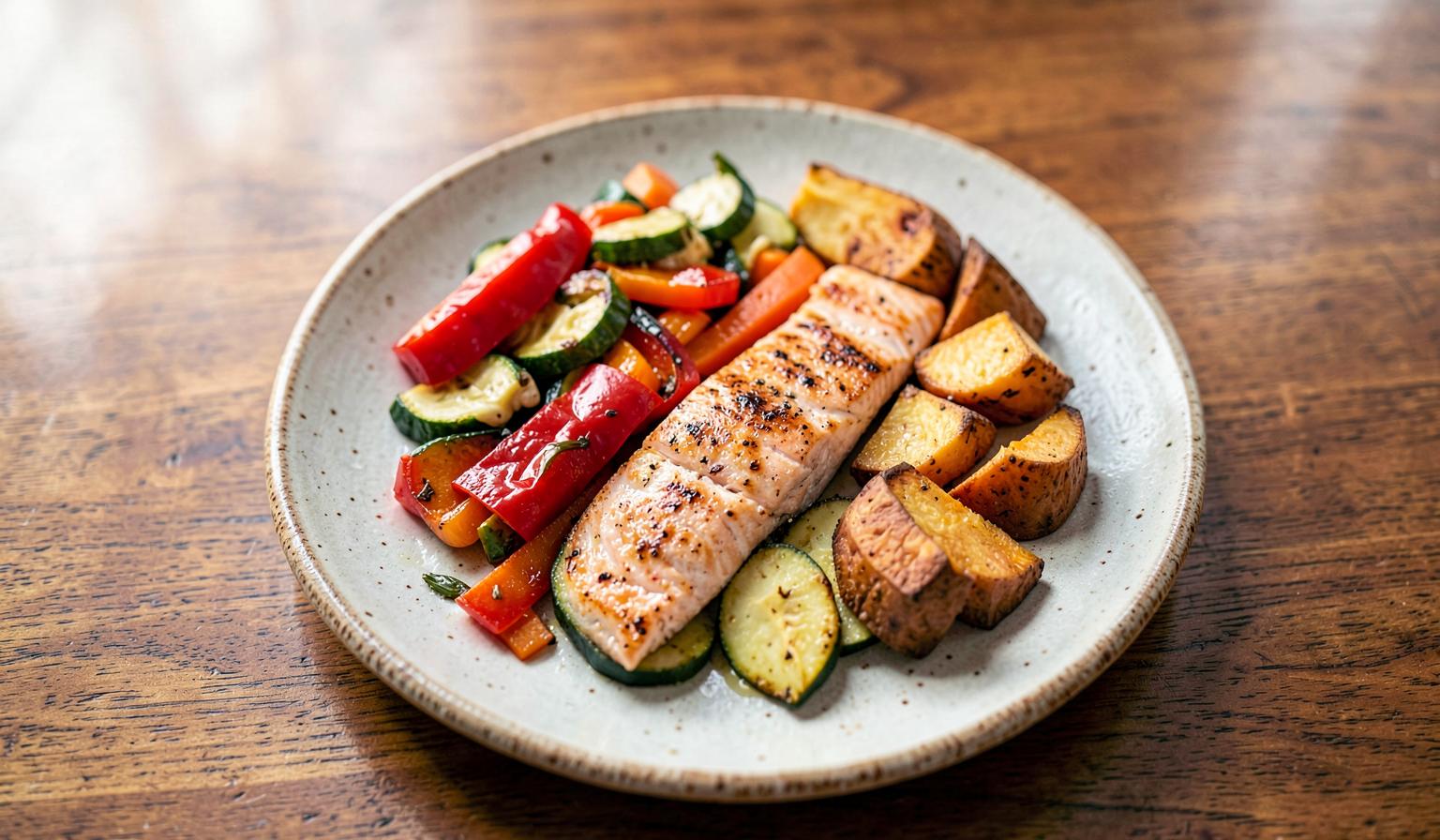
Build most of your meals around a simple balanced plate: half vegetables, a quarter protein, a quarter starch, ideally fiber-rich. Fish with plenty of vegetables and sweet potato. Chicken with a colourful salad and quinoa. Then add a small amount of good fat — olive oil, avocado, nuts. This structure gives you filling meals without constant calorie counting, and it leaves room for traditional starches like cassava or yam, as long as you watch the portion and the overall balance.
Make fiber your ally
Fiber — the part of plant foods your digestive system doesn't fully break down — is especially useful at this stage. It extends satiety, keeps transit regular, helps manage blood sugar, supports heart health, and feeds the beneficial bacteria in your gut. You'll find it in vegetables, whole fruit, legumes, oats, whole grains, nuts, and seeds.
If your digestion is sensitive, increase fiber gradually and drink enough water — otherwise the effect can be the opposite of what you want.
Watch the calories that don't fill you up
With age, energy needs can fall, especially when you lose muscle or move less. That doesn't mean eating very little — it means making room for the foods that genuinely nourish you. Sugary drinks, pastries, automatic snacking, ultra-processed foods, and alcohol share one thing: lots of energy, little satiety. The goal isn't to ban them. It's to keep them from crowding out the foods that actually support your muscle and your energy.
Don't fear good fats — but mind the portion
Olive oil, nuts, seeds, avocado, and fatty fish — salmon, sardines, mackerel, herring, trout — all belong here. Fatty fish provide omega-3s, the essential fats the body can't make in sufficient amounts, which support cardiovascular health among other things. The catch: even good fats are energy-dense. A small handful of nuts is excellent. The whole bag in front of the TV is another story.
Protect your bones alongside your muscle
Falling estrogen speeds up bone loss in some women, and bones can become more fragile. The trio of calcium, vitamin D, and protein — combined with resistance training — becomes important. Calcium is found in dairy, fortified plant beverages, some calcium-set tofus, and sardines eaten with their soft bones. Vitamin D, in turn, helps the body absorb that calcium. It's a good example of why I dislike single-goal strategies: here, what protects your muscle also protects your bones.
Tired since menopause? Don't blame it all on hormones
Menopause can contribute to fatigue — hot flashes and night sweats disrupt sleep, and many women notice a dip in energy. But significant or persistent fatigue deserves more than a shrug and another coffee. Iron deficiency, a thyroid issue, a sleep disorder, or other conditions can contribute just as much. Before fighting fatigue with caffeine or supplements, look for the cause — ideally with a health professional. It's one of the few things in this article that diet alone won't fix.
Sleep weighs on your weight more than you'd think
Sleep is part of the strategy, not beside it. Insufficient or poor-quality sleep disrupts the mechanisms of hunger and fullness, increases cravings, and lowers the energy available to move. In menopause, weight management isn't decided in the kitchen alone: nutrition, physical activity, sleep, and stress management move together. Neglect one and you weaken the others.
Why resistance training changes everything
If you want to limit abdominal fat after 40 or 50, don't rely on cardio alone. Walking, dancing, cycling, swimming — all excellent for the heart, so keep them. But add resistance training: the exercises that work your muscles against resistance, whether weights, bands, machines, or just your own body weight. That's what preserves and builds muscle, strength, and independence. And when it comes to aging well, muscle is what you want to protect first.
10 practical tips to limit belly fat in menopause
1. A protein source at all three main meals — to preserve muscle and extend satiety.
2. Half the plate as vegetables at lunch and dinner — lots of nutrients and fiber for few calories.
3. Fiber-rich starches, more often — oats, quinoa, whole grains, sweet potato, legumes. Traditional starches (cassava, yam, plantain) stay possible with attention to portion.
4. Eat your fruit rather than drink it — whole fruit fills you up more than juice, thanks to fiber.
5. Drink mostly water — sugary drinks and alcohol add calories fast without filling you up.
6. Pair protein with fiber — Greek yogurt + fruit, apple + nuts, veggies + hummus. The combination extends satiety.
7. Good fats, in reasonable portions — nutritious, but energy-dense.
8. Don't skip meals if it leaves you starving at night — some handle fasting well; others lose control of portions late in the day. Notice what works for you.
9. Sweet and ultra-processed foods: occasional, not daily — they have a place, as long as they don't become the base.
10. Don't chase only the scale: protect your muscle — the scale won't tell you whether you lost fat or muscle. The two are not equal.
Juliana's take
No, you're not sentenced to gain weight or belly fat because you're in menopause. Your body is changing, and some strategies simply need to evolve with it. Rather than a crash diet — which would mostly cost you muscle — focus on the levers that genuinely matter long term: protein, fiber, a balanced plate, minimally processed foods, resistance training, daily movement, sleep, and consistency.
And stop measuring all your progress with the scale alone. Preserving your muscle, keeping a waist size that serves your health, having energy, and staying strong are wins the morning number doesn't capture. After 40 or 50, the goal isn't to weigh less. It's to stay strong and healthy.
To go further, read our cassava nutrition guide.
Frequently asked questions
Is it normal to gain belly fat during menopause?
The hormonal changes of menopause can encourage fat to redistribute toward the abdomen. It doesn't mean every woman will necessarily gain weight — physical activity, muscle mass, sleep, and diet all continue to play a major role.
Does menopause slow your metabolism?
Aging can lower energy expenditure, especially when you lose muscle or become less active. Menopause doesn't act alone: age, hormones, muscle, and lifestyle interact. Preserving muscle is the strongest lever on metabolism.
How do you lose belly fat in menopause?
You can't choose where the body loses fat. The strategy is to encourage an overall reduction in fat when needed while preserving muscle — through protein spread across the day, resistance training, regular activity, and good sleep. Avoid crash diets: they mostly cost you muscle.
What should you eat during menopause?
Protein at every meal (eggs, Greek yogurt, fish, poultry, tofu, legumes), plenty of vegetables, whole fruit, fiber-rich starches (oats, quinoa, sweet potato), good fats in reasonable portions (olive oil, nuts, fatty fish), and sources of calcium and vitamin D to protect your bones.
What foods should you avoid in menopause?
No food is forbidden, but some are best kept occasional: sugary drinks, alcohol, pastries, automatic snacking, and ultra-processed foods — lots of calories, little satiety. What matters is that they don't crowd out the foods supporting your muscle and energy.
Do I need to cut carbs to lose belly fat in menopause?
No. Carbohydrates have a place in a balanced menopause diet. It's more useful to work on portions, food quality, and plate balance than to eliminate an entire food group.
Should I eat more protein after menopause?
Protein becomes especially important with age because it helps maintain muscle mass. The ideal is to spread it across the day rather than concentrating it all at dinner.
Why am I more tired since menopause?
Hormonal shifts and sleep disruption can contribute, but significant or persistent fatigue shouldn't be attributed to menopause by default. A medical assessment can help rule out iron deficiency, a thyroid problem, or a sleep disorder.
References
- Szeliga A, et al.. The impact of the menopausal transition on body composition across different body mass categories. 2026.
- Menzies C, et al.. Menopause, female sex hormones, skeletal muscle mass and muscle protein turnover: a narrative review. 2026.
- Liu Y, et al.. Dietary interventions and nutritional strategies for menopausal health: a comprehensive review. 2025.
- Huang HW, et al.. Management of obesity in menopausal women. 2025.
- Isenmann E, et al.. Resistance training alters body composition in middle-aged women depending on menopausal status. 2023.
- Erdélyi A, et al.. The importance of nutrition in menopause and perimenopause — a review. 2023.
- Troìa L, et al.. Sleep disturbance and perimenopause: a narrative review. 2025.
- Sparks JR, et al.. Menopause-related changes in sleep and the associations with cardiometabolic risk. 2025.
About the author
Juliana Dosy, Master of Science in Nutrition with over 17 years of clinical experience and founder of Club NutriChoix. She supports women living with hormonal imbalances — uterine fibroids, endometriosis, PCOS — by combining gut health, estrogen balance, and science-based anti-inflammatory nutrition.
For personalized support through our registered dietitian-nutritionist consultation service, book here: Book an appointment.