Expert guide · Juliana Dosy
Is Cassava Healthy? Nutrition, Glycemic Index, Gut Health, and Safe Preparation
Cassava feeds close to 800 million people. In Haiti it becomes cassave — the flat, slightly smoky bread that has fed families for generations. Here is what the evidence actually shows.
This content is for educational purposes only and does not replace personalized advice from a qualified health professional. Consult your physician or a registered dietitian for any medical condition.
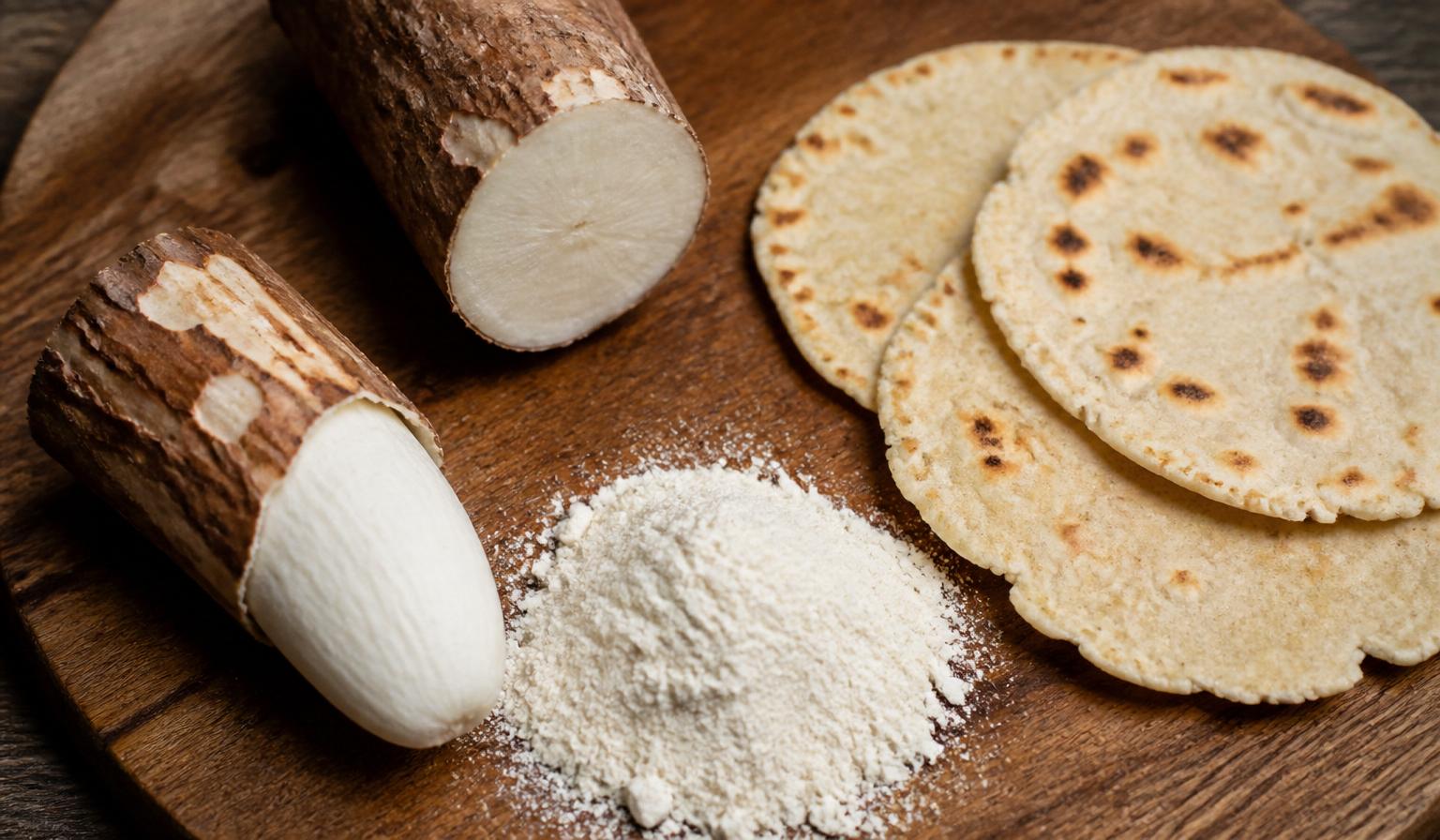
In Côte d'Ivoire, cassava becomes fermented attiéké. In Nigeria, dried gari. In Brazil, the dough for pão de queijo. Same plant, dozens of identities, every continent in between. What it is not, despite what keto-adjacent internet content would have you believe, is a food to fear. The question worth asking is not whether cassava is "safe" — it is how to work with it well.
What is cassava? (And what part do you eat?)
Cassava (Manihot esculenta Crantz) is a tropical root vegetable native to South America, now a dietary staple across Africa, the Caribbean, Latin America, and parts of Asia.
The root — often labelled yuca in grocery stores — is primarily a starch and energy source. Boil it, ferment it, dry and mill it into cassava flour, or press it into tapioca. The leaves are eaten as a vegetable across much of Africa and Asia and are nutritionally interesting: up to 25% protein by dry weight, plus fiber, calcium, iron, and folate. Both parts require proper preparation.
Cassava nutrition facts: what you're actually getting
Per 100 g of boiled cassava root, you get roughly 38 g of carbohydrates, 1.8 g of fiber, 160 calories, a useful amount of vitamin C, and some potassium. Protein sits near zero — about 1.4 g.
That last number matters. Cassava is starch, not protein. Pair it with grilled fish, eggs, chicken, or legumes and the picture changes entirely.
The nutritional profile also shifts by preparation. Yellow-fleshed varieties carry more carotenoids. Whole boiled cassava retains more fiber than tapioca pearls. Cassava flour lands in between — the fiber content varies enough by brand that reading the label is worth your time.
Cassava glycemic index: why the number you've seen might be wrong
The measured GI of cassava products ranges from approximately 46 to over 90 across published studies — and both ends are real, just for different products prepared differently:
| Cassava product | Observed GI |
|---|---|
| Boiled cassava — Kenyan variety | 46 |
| Boiled cassava — other studies | 74 |
| Boiled cassava — international tables | 94 ± 11 |
| Fufu | 84 |
| Gari | 92 |
| Tapioca | 78–96 |
Sources: Eleazu & Eleazu, 2012; Atkinson, Foster-Powell & Brand-Miller, 2008.
For people managing diabetes or prediabetes: the product and preparation method determine the glycemic impact, not cassava as a category. A 110 g serving of boiled cassava alongside vegetables and fish behaves very differently from a bowl of tapioca with sugar.
Cassava and gut health: resistant starch and prebiotic potential
Roughly 15% of cassava's starch is resistant starch — a fraction that escapes digestion in the small intestine and reaches the colon, where gut bacteria ferment it, producing short-chain fatty acids including butyrate.
Some varieties also contain fructooligosaccharides (FOS), which selectively feed Bifidobacterium. A 2024 study in Food Research International found prebiotic activity and improvements in gut microbiota among people with celiac disease (Mafaldo et al., 2024).
Practical implication: cook cassava and let it cool before eating. Cooling triggers starch retrogradation, converting digestible starch into resistant starch. For deeper reading on the microbiome connection, see our IBS nutrition guide.
How to eat cassava as part of a balanced meal
At Club NutriChoix, the VPF model structures every plate: Vegetables 50% | Protein 25% | Fiber-Rich Starches 25%.
Cassava occupies the starchy quarter. A practical serving is about ¾ cup (110 g) of boiled cassava — roughly a medium fist. That gives you ~45 g of carbohydrates and 2 g of fiber.
- Boiled cassava + grilled mackerel + spinach and tomato salad
- Chilled cassava salad + black beans + roasted peppers
- Attiéké + grilled chicken + sautéed greens and onion
- Cassave + fried egg + sliced cucumber and avocado
Cassava flour vs. tapioca starch: not the same thing
Cassava flour is made from the whole dried root — peeled, dried, and milled — and retains its fiber and some micronutrients. It is what traditional flatbreads like cassave are made from.
Tapioca starch is extracted only from the starch inside the root. The fiber is gone. The result is a nearly pure starch with a very high glycemic index.
Both are naturally gluten-free — genuinely useful for people with celiac disease. Just do not assume gluten-free equals nutritionally superior.
Safe preparation: what you need to know about cyanogenic compounds
Raw cassava contains cyanogenic glycosides — linamarin and lotaustraline. Bitter varieties contain significantly more than sweet ones. This is not a reason to avoid cassava; it is a reason to prepare it correctly.
Reduce cyanogenic compounds by: peeling fully, cutting or grating, soaking 12–24 hours, fermenting where applicable (attiéké, gari, fufu, chikwangue), pressing and drying if required, and cooking thoroughly. Soaking plus cooking eliminates up to 95% of cyanogenic compounds.
The short version: never eat cassava raw.
Cassava across cultures: why the form matters
- Haiti / Caribbean: cassave — a thin, crisp flatbread from grated, pressed, dry-roasted cassava.
- Côte d'Ivoire: attiéké — fermented, steamed semolina. Lower GI, higher resistant starch thanks to fermentation.
- Nigeria / West Africa: gari — dried, toasted granules. High GI, but portable and shelf-stable.
- Congo / Central Africa: chikwangue — fermented dough wrapped and steamed in leaves.
- Brazil: tapioca crepes and pão de queijo — cassava starch for texture and binding.
For more cultural and clinical questions, browse Ask Juliana or start your personalized assessment.
Frequently asked questions about cassava
Is cassava good for weight loss?
Cassava is not a weight-loss food on its own, but it can fit into a weight-management approach when portioned correctly (about 110 g boiled), paired with vegetables and protein, and prepared without added fat. Resistant starch and fiber may help extend satiety.
Is cassava safe for diabetics?
Yes, with attention to portion size, preparation method, and meal composition. A 110 g serving of boiled cassava alongside protein and vegetables produces a different blood sugar response than the same amount of tapioca eaten alone.
Is cassava gluten-free?
Yes. Both the root and cassava flour are naturally gluten-free, making them genuinely useful for people with celiac disease.
Does cassava feed gut bacteria?
Cassava contains resistant starch and FOS, both of which may feed beneficial bacteria in the gut microbiome. Fermented and cooled preparations appear to have the strongest prebiotic effect.
Can you eat cassava raw?
No. Raw cassava contains cyanogenic compounds that can be harmful. Always peel, soak where needed, and cook thoroughly.
Scientific references
- Montagnac JA, Davis CR, Tanumihardjo SA. Nutritional value of cassava for use as a staple food. Compr Rev Food Sci Food Saf. 2009;8(3):181–194.
- Failla ML, Chitchumroonchokchai C, Ferruzzi MG. Retention and bioaccessibility of carotenoids and vitamin C in cassava. J Food Compos Anal. 2012;25(1):30–37.
- Chandrasekara A, Kumar TJ. Roots and tuber crops as functional foods. Int J Food Sci. 2016;2016:3631647.
- Cumbana A et al. Reduction of cyanide content of cassava flour by the wetting method. Food Chem. 2007;101(3):894–897.
- Mafaldo IM, Souza VGS, Santos EF et al. Cassava Brazilian cultivars have prebiotic potential and beneficially modulate the intestinal microbiota of celiac individuals. Food Res Int. 2024;191:114765.
- Eleazu CO, Eleazu KC. Glycemic index of cassava products. Curr Res Nutr Food Sci. 2012;6(2):108–113.
- FAO. Save and Grow: Cassava. Rome: FAO; 2013.
- Health Canada. Canada's Food Guide. 2019.
- Atkinson FS, Foster-Powell K, Brand-Miller JC. International tables of glycemic index and glycemic load values. Diabetes Care. 2008;31(12):2281–2283.
About the author
Juliana Dosy, M.Sc., nutrition coach, is the founder of Club NutriChoix and a speaker with more than 17 years of experience supporting women in building sustainable healthy eating habits. This guide draws from her conference presentation on cassava nutrition, delivered at the Journées culinaires du manioc in Montréal, July 2026.
This content is for educational purposes only and does not replace personalized advice from a qualified health professional.