I have fibroids: can yam make them grow because of estrogen?
Written by Juliana Dosy, M.Sc. Nutrition · Updated
"Juliana, I have fibroids and someone told me to stop eating yam because it supposedly contains substances that raise estrogen and could grow my fibroids. I've eaten it my whole life and now I'm worried. Should I really avoid it?"
Short answer
No. Current scientific evidence does not justify banning yam for women with fibroids.
What yam actually is
There's a lot of confusion around yam, hormones, and a plant compound called diosgenin — a substance naturally present in certain yam species, whose chemical structure resembles some hormones. That resemblance is exactly why it has long interested researchers and the pharmaceutical industry. But "yam contains a compound chemically similar to certain hormones" and "eating yam raises estrogen and grows fibroids" are two completely different claims. To date, no clinical study shows that eating yam causes fibroids to appear or grows existing ones — and none shows it shrinks them either. Before cutting out an important traditional food, this distinction is worth understanding.
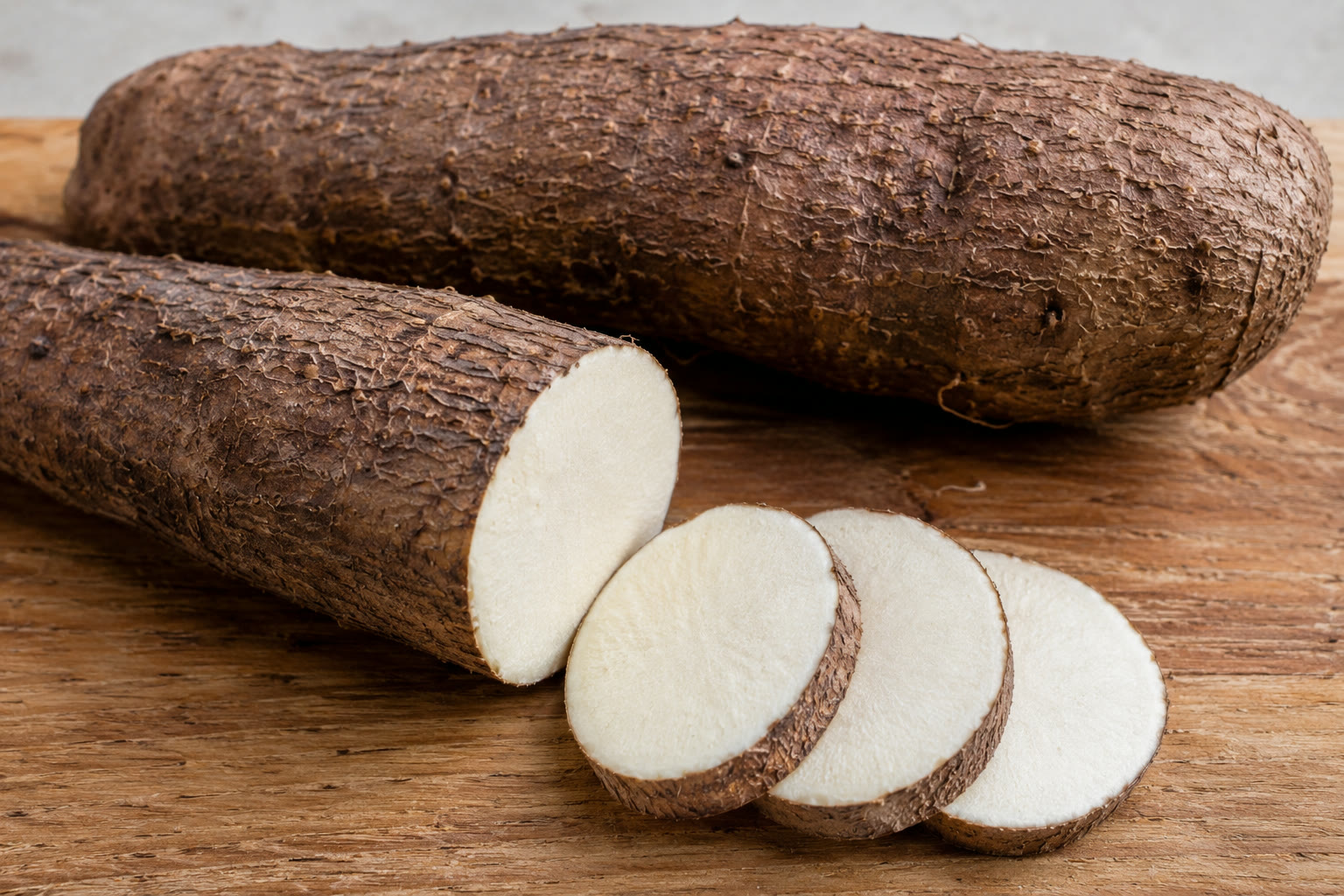
Yam is sometimes confused with sweet potato, but they're different foods. True yams belong to the botanical genus Dioscorea, which includes several hundred species, widely eaten across Africa, the Caribbean, Asia, and other tropical regions. Depending on the variety, the flesh can be white, yellow, or purplish, and it's prepared boiled, mashed, baked, fried, or milled into flour.
Nutritionally, yam is primarily a starch-rich staple, in the same category as rice, potato, cassava, or plantain. It also provides fiber, potassium, and various plant compounds that vary by species — and some species happen to contain diosgenin. That's likely where the confusion between yam, estrogen, and fibroids begins.
Why yam gets linked to hormones
Diosgenin belongs to a family of plant compounds called steroidal saponins. The name can sound alarming, but it doesn't mean yam contains hormones like the ones our bodies produce — only that its chemical structure shares some resemblance with steroid hormones. Diosgenin has, in fact, been used as a raw material by the pharmaceutical industry to manufacture certain hormones in a lab.
And here's where the distinction matters: your body is not a pharmaceutical plant. Converting diosgenin into hormones requires several chemical reactions carried out industrially. Simply eating yam doesn't mean your body automatically converts its diosgenin into estrogen. Eating yam is not the same as taking estrogen.
What about the study that showed a hormone increase?
Yes, it exists, and it's worth explaining because it's easy to misread. A small study published in 2005 asked 24 healthy postmenopausal women to replace much of their usual starches with about 390g of yam per day for 30 days; 22 completed it. Afterward, researchers observed a rise in estrone and a near-significant rise in estradiol — two forms of estrogen — along with an increase in SHBG, a liver protein that transports sex hormones in the blood and determines how much circulates in active form (Wu et al., J Am Coll Nutr, 2005).
You could read that and conclude: "there it is, yam raises estrogen, so it must grow fibroids." But that goes well beyond what the study actually supports. It has real limitations: a very small sample (24, then 22 women), healthy postmenopausal participants — not women with fibroids — a very high daily amount of yam, and, most importantly, the researchers never measured fibroids at all. Not their appearance, their size, or their growth. The study shows that high consumption of one specific yam species (Dioscorea alata) was associated with hormonal marker changes in a small group of postmenopausal women. It does not show that eating yam grows fibroids.
Why estrogen comes up when we talk about fibroids
Fibroids are hormone-dependent benign tumors: non-cancerous cell growth that certain hormones, particularly estrogen and progesterone, can influence. That's true, and it matters. But it doesn't mean every food that might mildly influence hormonal activity needs to disappear from the plate. Fibroid development is far more complex than one food — hormones, genetics, age, environment, body weight, and likely certain lifestyle factors all interact.
What the science actually says about diet and fibroids in 2026
A major 2025 review analyzed the evidence on nutrition and fibroids; its authors conclude that certain dietary factors may be associated with fibroid risk or progression, but current data don't yet support turning any single food into an established treatment (Martire et al., J Clin Med, 2025). A newer review published in March 2026 looked not at isolated foods but at overall dietary patterns — how someone eats as a whole over years, rather than one meal or one ingredient (Fresco et al., npj Women's Health, 2026). Its findings suggest that higher-quality dietary patterns may be associated with better gynecological health, while lower-quality diets high in ultra-processed foods may be linked to more problems — though the authors themselves flag the significant limits of what's currently known.
In short: we're beginning to understand possible links between diet and fibroids, but we're far from being able to draw up a scientific list of foods that "feed," "shrink," or "destroy" fibroids.
So where does yam fit?
To date, there is no clinical evidence that regular yam consumption causes fibroids or speeds their growth. There's no scientific reason to ban it outright. But I want to be equally careful in the other direction: yam is not a fibroid treatment either. You'll sometimes see claims online that certain foods "balance hormones," "cleanse the uterus," or "shrink" fibroids — current evidence doesn't support attributing those powers to yam. A food can support a healthy diet without becoming medicine.
One more distinction worth making: eating yam as a food and taking a concentrated yam extract or supplement are not the same thing. An extract concentrates certain compounds at levels very different from a normal food portion, and different yam species don't necessarily share the same composition. Results from a study on an extract or one specific species don't automatically apply to all the yam eaten in everyday meals.
My practical advice
If yam is part of your family's food culture and you enjoy it, you don't need to cut it because you have fibroids. Treat it simply as your starch portion, in a balanced plate — half vegetables, a quarter yam, a quarter protein. Picture boiled yam, fish or chicken, and a generous portion of colourful vegetables. Boiled, baked, or worked into a homemade dish, yam has a place in a balanced diet. What matters more than demonizing a single food is what you eat day after day, meal after meal.
Key takeaway
Living with fibroids? You don't need to fear yam. To date, we have no evidence it causes fibroids or speeds their growth — and no evidence it makes them disappear either. The relationship between diet, hormones, and fibroids is far more complex than any single food. Yam can stay on your plate, as part of a varied, balanced diet — without crediting it with the power to cause fibroids, and without crediting it with the power to cure them either.
This content is educational and does not replace personalized medical advice. It is based on a real question submitted anonymously.
To go further, read our complete nutrition guide for uterine fibroids.
Frequently asked questions
Does yam raise estrogen?
A small study in postmenopausal women observed changes in certain hormonal markers after high daily consumption of one specific yam species for 30 days. But the study was small, didn't involve women with fibroids, and didn't measure fibroid growth. It doesn't support the conclusion that eating yam grows fibroids.
What is diosgenin in yam?
Diosgenin is a plant compound naturally present in certain yam species. It's used as a raw material by the pharmaceutical industry to manufacture certain hormones through lab-based chemical processes — that doesn't mean your body automatically converts the diosgenin in the yam you eat into estrogen.
Is eating yam the same as taking hormones?
No. Yam is a food. Even though some species contain compounds whose structure interests researchers because of hormone links, eating a portion of yam is not equivalent to hormone treatment.
Can yam make fibroids grow?
To date, no clinical study shows this. Current evidence doesn't justify systematically eliminating yam because of fibroids.
Can yam shrink or "dry out" fibroids?
No evidence supports that either. Yam is a nutritious food that can be part of a balanced diet, but it isn't a medical treatment for fibroids.
Can I eat yam every week if I have fibroids?
Yes. There's no specific frequency to follow. Vary your starches and look at the balance of your diet as a whole.
What foods should I absolutely avoid if I have fibroids?
There's no universal list of forbidden foods proven to stop fibroids from growing. Current research points more toward overall diet quality and lifestyle habits than banning a single food arbitrarily.
Can the right diet make my fibroids disappear?
No. A balanced diet can support overall health and certain metabolic and hormonal factors, but it doesn't replace medical follow-up. Heavy bleeding, pain, anemia, or significant pelvic pressure require a medical evaluation.
References
- Fresco TM, Tussing-Humphreys LM, Kim SJ, et al.. State of the science and research opportunities on dietary patterns in endometriosis and uterine fibroids. npj Women's Health. 2026.
- Martire FG, Costantini E, Ianes I, et al.. Nutrition and uterine fibroids: clinical impact and emerging therapeutic perspectives. Journal of Clinical Medicine. 2025.
- Wójcik M, et al.. The role of nutrition in pathogenesis of uterine fibroids. Literature review on diet, nutrients, and uterine fibroids.
- Wu WH, Liu LY, Chung CJ, Jou HJ, Wang TA.. Estrogenic effect of yam ingestion in healthy postmenopausal women. Journal of the American College of Nutrition. 2005.
About the author
Juliana Dosy, Master of Science in Nutrition with over 17 years of clinical experience and founder of Club NutriChoix. She supports women living with hormonal imbalances — uterine fibroids, endometriosis, PCOS — by combining gut health, estrogen balance, and science-based anti-inflammatory nutrition.
For personalized support, our ODNQ-registered dietitian-nutritionists see clients in Lachine and online anywhere in Quebec, with insurance receipts: meet our Lachine dietitians.