Expert guide · Juliana Dosy
IBS: Why Certain Foods Turn on You (and How to Actually Figure Out Which Ones)
You ate the exact same chicken sandwich you had last week. This time your stomach swells up before you've even finished chewing. That inconsistency is what makes IBS so hard to live with — and even harder to explain.
This content is for educational purposes only and does not replace personalized advice from a qualified health professional. Consult your physician or a registered dietitian for any medical condition.
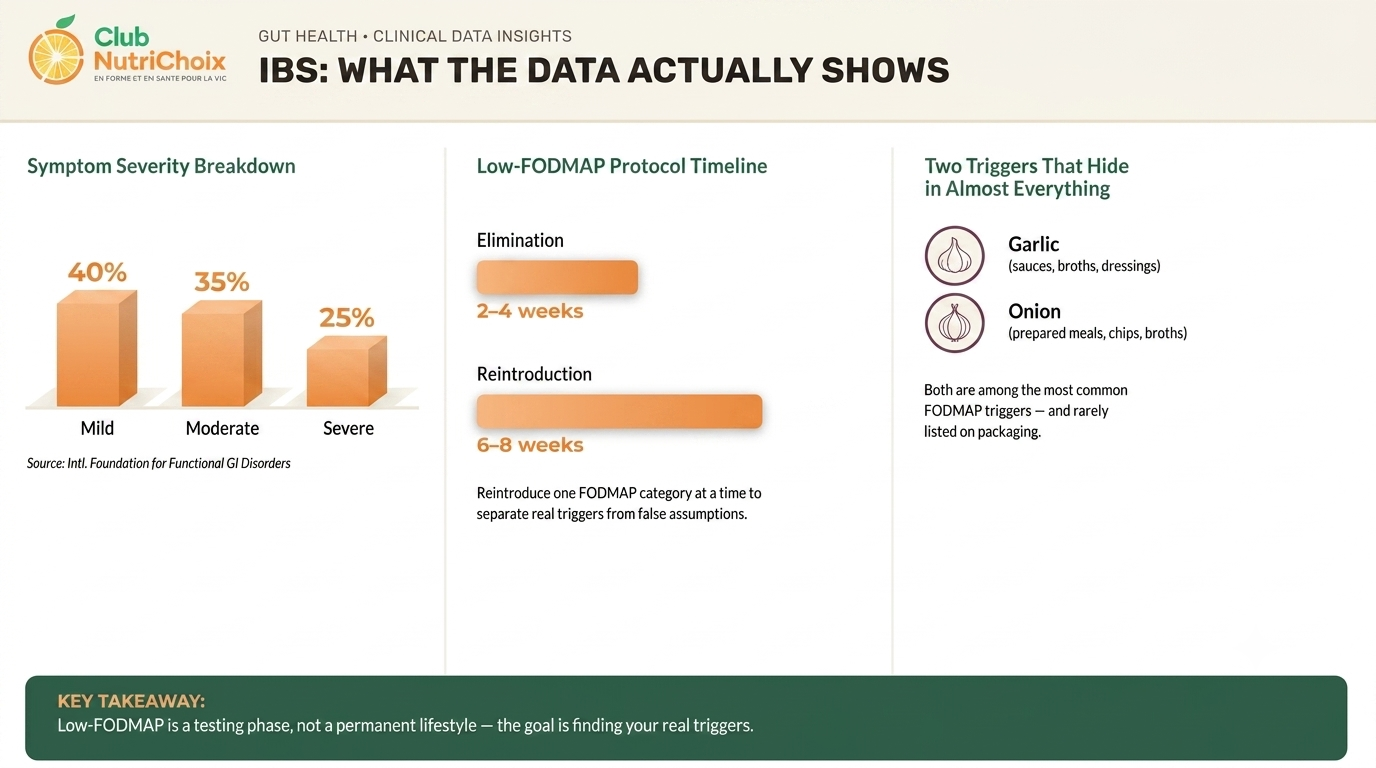
IBS affects up to 15% of adults, and twice as many women as men. Hormones, stress, microbiome, and diet are four levers to address together. See your doctor to rule out other causes before starting a restrictive approach.
Irritable bowel syndrome drives millions of searches every month across Canada, which gives some sense of how many people are looking for an answer at three in the morning, doubled over. And yet the advice handed out most often — "cut gluten, cut dairy" — misses the actual mechanism almost entirely.
It's not one food. It's a communication breakdown.
IBS doesn't damage the intestine
No visible inflammation, no lesion, nothing a colonoscopy would catch. What actually malfunctions is the communication line between your brain and your digestive system — what's called the gut-brain axis. The nerve signals between the two start misfiring. The colon contracts too fast, too slow, or in unpredictable bursts, a bit like choreography someone synced badly.
Three patterns tend to show up. Some people live mostly with constipation — hard stools, that feeling of never quite finishing. Others get the opposite: urgency, loose stools, multiple trips to the bathroom before lunch. And there's a third group, the least predictable of all, that swings between both, sometimes within the same week, sometimes the same day.
The real culprit has an awkward name: FODMAPs
Here's what explains the chicken sandwich that's fine one week and disastrous the next: FODMAPs. The acronym covers a group of fermentable carbohydrates — found in wheat, onion, garlic, legumes, certain fruits, milk — that the small intestine absorbs poorly. Those undigested carbs travel on to the colon, where bacteria feed on them and produce gas through fermentation. In someone without IBS, this process goes unnoticed. In you, the gut lining is more sensitive, and that same ordinary gas triggers real pain.
Onion and garlic are probably the two most underestimated triggers in this whole conversation. They hide in almost everything — sauces, broths, prepared meals, salad dressings — and rank among the most common offenders.
What a food diary reveals that months of guessing didn't
Two weeks of precise notes — the time, what you ate, pain rated out of ten, what you were doing right before it started — is often enough to surface a pattern that months of assumptions never caught. Some people discover it was never the coffee itself, but the speed at which they drink it while running for the bus. Others notice their flare-ups land almost exactly two days before their period, a real hormonal link, since estrogen and progesterone directly affect intestinal motility.
A properly done low-FODMAP approach has two distinct phases. First, high-FODMAP foods come out for two to four weeks — not indefinitely, which is one of the most common mistakes people make. Then each category gets reintroduced one at a time, over several weeks, to pin down exactly what's actually a problem and what, it turns out, never was.
What tends to sit easier on the plate
Bananas that are ripe but not overripe, blueberries, grapes, carrots, zucchini, rice, quinoa, aged cheeses, firm tofu. Kefir too, oddly enough, despite being dairy — fermentation breaks down enough of the lactose that most sensitive guts handle it fine.
IBS foods to avoid — at least for now
Raw garlic and onion, legumes in large amounts, wheat, unfermented dairy, stone fruits, carbonated drinks, alcohol. Coffee too, not necessarily because of the caffeine, but because drinking it fast, on an empty stomach, while walking, tends to make everything worse in a gut that's already reacting to more than it should.
Stress isn't "all in your head"
Because the gut and the brain run on the same communication line, a nervous system stuck in a constant state of alert literally makes intestinal contractions more frequent and pain sensitivity sharper. That's not a vague explanation or psychology dressed up as an excuse. It's a documented physiological mechanism, just as real as the reaction to FODMAPs themselves.
What this looks like in an ordinary week
Eating slower, away from a screen, sometimes changes more than cutting out an entire food group. Splitting meals into smaller, more frequent portions reduces the load the colon has to process all at once. And keeping that food diary, even for two weeks, is worth more than any generic list found online, because your IBS doesn't look exactly like the IBS of the person sitting next to you in the waiting room.
Want a structured starting point? Take our personalized gut-health assessment or browse the full library of nutrition guides, including our companion piece on fibroids and diet.
Frequently asked questions
What should I eat if I have IBS?
Low-FODMAP foods tend to be better tolerated: ripe bananas, carrots, rice, quinoa, aged cheeses, and firm tofu. Tolerance still varies from person to person, which is why a food diary is worth keeping.
What foods should I avoid with IBS?
Raw garlic and onion, wheat, legumes in large amounts, unfermented dairy, alcohol, and carbonated drinks are among the most common triggers.
Can stress actually cause IBS flare-ups?
Yes. The gut and brain communicate through the same nervous system. Sustained stress increases both the frequency of intestinal contractions and sensitivity to pain.
How long should someone follow a low-FODMAP diet?
The elimination phase typically runs two to four weeks, followed by a gradual, food-by-food reintroduction to identify real triggers rather than restricting indefinitely.
About the author
Related reading: cassava, resistant starch and the gut microbiome.
This article was written by Juliana Dosy, nutrition coach with over 17 years of clinical experience and founder of Club NutriChoix.
For personalized support, including an assessment through our registered dietitian-nutritionist consultation service, book here.