Is Whey Protein Good for You? Should You Take It?
Written by Juliana Dosy, M.Sc. Nutrition · Updated
"Juliana, I want to build muscle and hit my protein target more easily. A friend recommended a whey isolate. Is it a good choice, is it safe, and is protein powder bad for the kidneys or digestion?" — question received August 2026
In this article
Short answer
Protein powders are among the best-selling supplements in the world and among the most misunderstood. For a healthy person, a quality whey can be a useful tool to top up your intake when meals alone don't get you to your target. It never replaces a balanced plate — it fills a gap.
What whey actually is
Some people think protein powders are only for bodybuilders; others are convinced they wreck your kidneys, liver, or gut. The reality sits between those two extremes, and everything else follows from that frame.
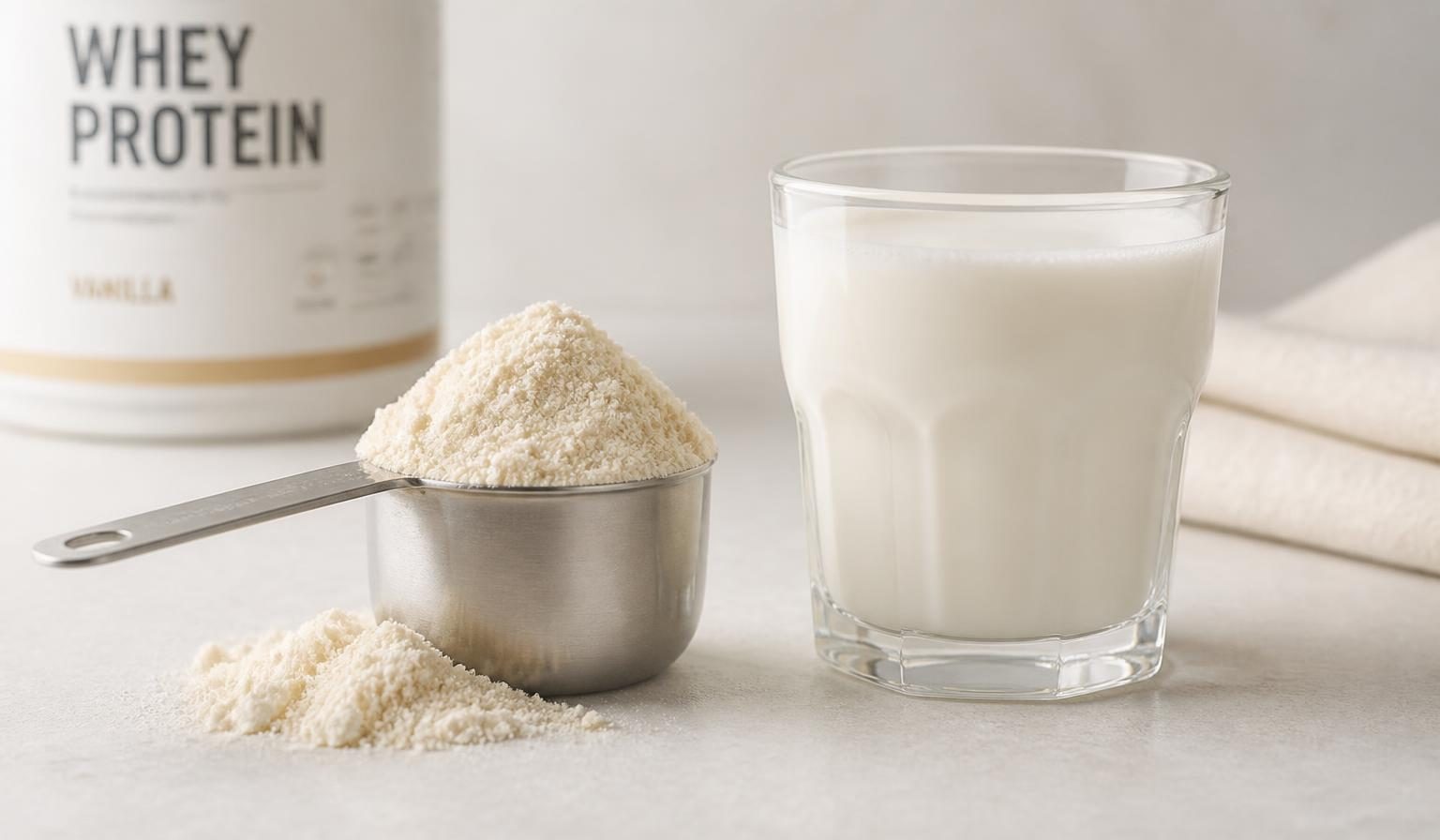
Whey is a protein found naturally in milk. When cheese is made, milk separates into two parts: casein and whey. That whey is then filtered and dried into a protein-rich powder.
There are three main forms, and the difference matters most for your digestion. Whey concentrate contains more lactose and a little more fat. Whey isolate is higher in protein and very low in lactose. Whey hydrolysate is partially pre-digested and used mostly in specific situations. If lactose doesn't sit well with you, remember one word: isolate. It's almost always the better-tolerated option.
Does whey actually build muscle?
Yes — it's probably the best-evidenced supplement in this area. Whey provides all the essential amino acids and is especially high in leucine, the amino acid that triggers muscle protein synthesis (Morton et al., Br J Sports Med, 2018).
But there's a condition, and it's the whole game. Those benefits show up when whey accompanies regular, progressive resistance training. Without the training, its effect on muscle is much smaller. The powder doesn't build muscle on its own — it supplies raw material while the effort sends the signal.
This matters most after 40, where enough protein plus resistance training becomes one of the best ways to hold onto the muscle mass that otherwise tends to slip with age.
Is whey protein bad for digestion?
This is where your question meets the heart of what I do, so let's slow down. Contrary to a common fear, whey isn't bad for digestion for most people. A well-chosen isolate is actually a light way to raise your protein without weighing meals down.
That said, some people do get bloating, gas, or discomfort. When that happens, the cause is almost always findable. Most often it's lactose — far higher in concentrate than in isolate. Sometimes it isn't the protein at all but the long list of sweeteners, flavours, and gums added to certain products, which ferment and bloat. Sometimes it's simply too big a serving swallowed too fast.
The fix is rarely to abandon whey: choose a short ingredient list, switch to isolate if lactose is the culprit, and start with a half serving to gauge your tolerance before scaling up.
Is whey dangerous for the kidneys?
In someone with healthy kidneys, current evidence does not show that high protein intake — from food or supplements — damages the kidneys (Antonio et al., J Nutr Metab). It's a stubborn fear, but it doesn't hold up in healthy people.
The important exception is chronic kidney disease: those affected should always check with their doctor or a qualified health professional before using a protein supplement, because protein management follows different rules in that situation.
Who actually benefits — and who doesn't need it
Whey can help those building muscle, preserving muscle after 40, people with a small appetite or a very active lifestyle, and some people losing weight who struggle to hit their protein needs while cutting calories.
On the other hand, if you already meet your needs easily through food, a supplement won't add magic on top. What I see often in practice: women who start out sure that powder is only for athletes, then realize when they add it up that they're eating 50 to 60 g of protein a day when their needs are considerably higher. For them, whey becomes a practical tool — not a transformation.
My practical advice
Start by aiming for your protein target with real food — legumes, fish, eggs, Greek yogurt. If you can't get there, then choose a whey with a short ingredient list, no added sugar, high protein per serving, and an isolate if lactose bothers you.
A serving of about 25 to 30 g provides enough leucine to activate muscle protein synthesis in most adults. Spread your protein across the day rather than piling it into one meal, and always pair it with regular resistance training — that's the combination that works. If you have kidney disease, talk to your doctor first. And where possible, choose a product independently tested by a body like NSF Certified for Sport or Informed Choice.
I see whey as a tool, not a solution. If the plate is already short on vegetables, fibre, or food-based protein, that's where the work starts. A supplement supports good habits; it never replaces them.
Frequently asked questions
Is whey protein bad for your kidneys?
In people with healthy kidneys, current evidence does not show that high protein intake damages the kidneys. People with chronic kidney disease should consult their doctor before taking a protein supplement.
Does whey protein cause bloating?
It can in some people, usually because of lactose (higher in concentrate) or added sweeteners and gums. Choosing a whey isolate with a short ingredient list and starting with a half serving usually resolves it.
Whey concentrate or isolate — which should I choose?
Isolate is higher in protein and very low in lactose, making it better tolerated, especially with lactose sensitivity. Concentrate is cheaper but contains more lactose and fat.
Should I take whey after 40?
It isn't required, but enough protein combined with resistance training helps preserve muscle mass after 40. Whey is a practical way to get there when food alone falls short.
Does whey replace a meal?
No. Whey complements your diet, it doesn't replace it. It works well added to Greek yogurt, a smoothie, or oats to raise protein intake.
References
- Morton RW, et al.. Protein supplementation and resistance training-induced gains in muscle mass and strength: systematic review and meta-analysis. Br J Sports Med. 2018.
- Jäger R, et al.. International Society of Sports Nutrition Position Stand: Protein and Exercise. JISSN. 2017.
- Phillips SM, Van Loon LJC.. Dietary protein for athletes: from requirements to optimum adaptation. J Sports Sci. 2011.
- Devries MC, Phillips SM.. Supplemental protein in support of muscle mass and health. Curr Opin Clin Nutr Metab Care. 2015.
- Hudson JL, et al.. Protein distribution across the day and muscle protein synthesis. Nutrients. 2020.
- Antonio J, et al.. High protein diets and kidney function in healthy adults. J Nutr Metab.
- Academy of Nutrition and Dietetics, Dietitians of Canada & American College of Sports Medicine. Nutrition and Athletic Performance. 2016.
About the author
Juliana Dosy, M.Sc. Nutrition, has over 17 years of clinical experience and founded Club NutriChoix. She explains digestive health, nutrition, and hormonal health using scientific evidence, without miracle claims.
For personalized support, our ODNQ-registered dietitian-nutritionists see clients in Lachine and online anywhere in Quebec, with insurance receipts: meet our Lachine dietitians.